Historical Monuments of Mtskheta

Mtskheta
Region of Mtskheta-Mtianeti


 Jvari (Holy Cross) Church 586/7-604/5

Jvari Church in Mtskheta – outstanding monument of Georgian architecture was one of the greatest religious sites and a center of pilgrimage for Christian nations of the Caucasus.
Jvari Church is built on the place where, at the beginning of the IV century, the Illuminatress of Georgia St. Nino and first Christian Georgian king Mirian erected a large wooden cross. An octagonal base of the cross is still preserved in the center of the church.
Jvari Church is a tetra-conch type with additional chambers. It was built by the ruler of Kartli Stephanos Patrikios on the turn of VI and VII centuries.
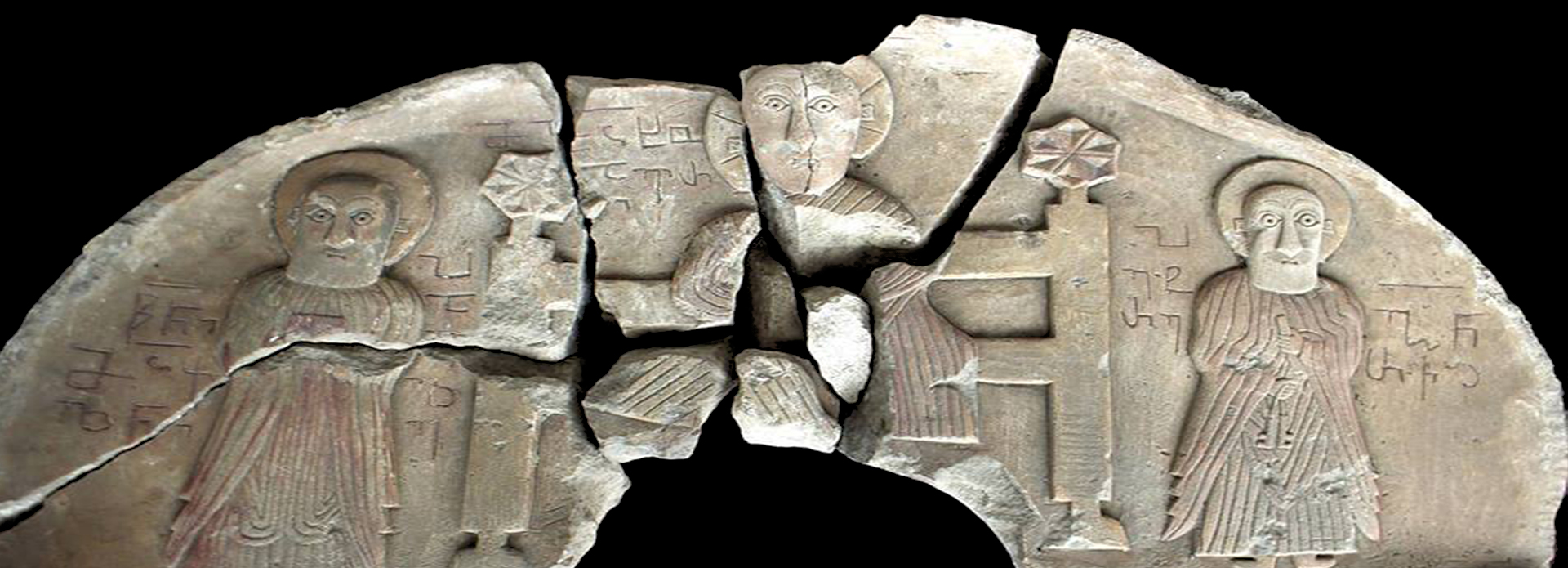
Jvari Church is the first Georgian church with the reliefs taking significant place in the decoration of the facades. The reliefs depicting the patrons - Stephanos and his family (Demetrius and Adarnas) are located on the Eastern façade of the Church. In the tympanum of the Southern façade there is a composition of Ascension of the Cross. On the facet of the drum of the dome a figure of an unidentified person is carved, possibly of the architect.
The small church of the Holy Cross on the North of Jvari Church is built in the second half of VI century.
The Jvari ensemble used to be surrounded with a fortification wall from the three sides.
Jvari church, together with other historical monuments of Mtskheta has been inscribed upon the World Heritage List of the Convention concerning the Protection of the World Cultural and Natural Heritage since 1994. Inscription on this list confirms the outstanding universal value of a cultural or natural property which deserves protection for the benefit of all humanity.


Svetitskhoveli Cathedral XI c

Svetitskhoveli Cathedral - the most important religious centre and the biggest ecclesiastic construction of mediaeval Georgia, was built in 1010-1029 under the leadership of the Catholicos Patriarch Melkisedec by an architect named Arsukidze.
In the IV century here was a wooden church. In the 480s a big three-aisled basilica was built on its place. The fragments of these earlier churches are still preserved.
Svetitskhoveli Cathedral represents “inscribed cross” type church with elongated West arm. During the centuries it underwent several restorations. In 1413-1440 king Aleksandre the Great restored the Western part of the cathedral and the collapsed cupola.
In XV century a small square domed chapel was built in the interior of the Cathedral which represented symbolic replica of the Holy Sepulcher in Jerusalem.
Svetitskhoveli had porches and apses of different periods from the South and North, which were destroyed in 1837.
The preserved mural paintings mostly date to XVII century.
The walls surrounding the courtyard of the Cathedral belong to the second half of XVIII century. On the West there is the XI century gate and fragments of the palace of Catholicos Patriarch Melkisedec.
Some of the Georgian kings (among them the last kings of Georgia Erekle II and Giorgi XII), Patriarchs (Melkisedec I, Domenti II) and Georgian nobles are buried in the Cathedral.
Svetitskhoveli Cathedral, together with other historical monuments of Mtskheta has been inscribed upon the World Heritage List of the Convention concerning the Protection of the World Cultural and Natural Heritage since 1994. Inscription on this list confirms the outstanding universal value of a cultural or natural property which deserves protection for the benefit of all humanity.


Samtavro Monastery XI c

Samtavro Monastery is built on the place where “Zemo Ecclesia” (Upper Church) was located in the 30s of the IV century. The first Christian royal couple - Mirian and Nana was buried here. Since the 480s Samtavro became an Episcopal see. Since the beginning of XIX century it has become a convent.
The present Church of the Savior was built in the 1030s-1040s. The preserved mural paintings in the altar conch and in the dome are dated to the mid-XVII century. The archeological excavations revealed the remains of a large church that had been standing here before XI century.
Eastwards of the Church of the Savior there is a small early medieval church of St. Nino. Its mural paintings are dated to XIX century.On the North of the Church there is a three storied bell tower of XV-XVI centuries. A cylindrical tower of XVIII century is preserved in the wall of the monastery that was restored in XIX century.
Samtavro Monastery, together with other historical monuments of Mtskheta has been inscribed upon the World Heritage List of the Convention concerning the Protection of the World Cultural and Natural Heritage since 1994. Inscription on this list confirms the outstanding universal value of a cultural or natural property which deserves protection for the benefit of all humanity.


Bagrati  Cathedral and Gelati Monastery

City of Kutaisi 
Region of Imereti


“Bagrati Cathedral” of Kutaisi 1003

The Cathedral of the Dormition of the Mother of God (so called Bagrati Cathedral) - the symbol of united Georgian kingdom was founded by the first king of united Georgia Bagrat III Bagrationi (978-1014). According to the inscription on the façade, the construction of the cathedral was completed in 1003.

Bagrati Cathedral is one of the biggest architectural monuments of Georgia. Its cupola was supported by four free standing pillars. In the Western arm on the second floor a gallery was arranged for the royal family.

Before the construction was finished, a three storied tower was added to the cathedral. In the first half of XI century the richly embellished porches were added from the South and West.

On the Eastern and Northern walls of Bagrati Cathedral there are carved inscriptions. The earliest inscription of Arabic numerals in Georgia is preserved on the Northern window of the cathedral.

At the end of XVII century the cathedral was blown up by invaders. Its destruction continued in XVII and XIX centuries.

The archaeological excavations of the territory of Bagrati Cathedral has revealed the cultural remains different periods, among them the fragments of a IV century church, the mosaic floor dated to 1003 and several royal burial vaults.


Gelati Monastery XII c.

Gelati Monastery - one of the greatest spiritual and cultural centers of the Middle Age Georgia praised as “New Athens” and “Second Jerusalem” was founded by King Davit Agmashenebeli (David the Builder) in 1106.

At the monastery there functioned an academy where outstanding Georgian scientists, philosophers and theologians lived and worked.

Since XVI century Gelati has become an Episcopal Cathedral.

The central building of the monastery is the church of the Virgin. The interior of the church is adorned with paintings of different periods. The central apse is decorated with a mosaic dated to 1125-1130 depicting the Virgin with the Child and archangels. In the Western narthex there are mural paintings of XII century representing seven ecumenical councils. Most of the murals in the church belong to the second half of XVI century.

Other architectural monuments of Gelati monastic ensemble date to XII and XIV centuries. These are: the academy, the church of St. George decorated with the interior mural paintings of XVI century, the two floored church of St. Nicholas and the bell tower, one of the oldest in Georgia.

Gelati Monastery was a burial vault of the Georgian royal dynasty of the Bagrations. The king David the Builder himself (1184-1225) is buried in the Southern gate of the monastery.


Upper Svaneti

Village of Chazhashi
Mestia District
Region of Samegrelo-Upper Svaneti


Upper (Zemo) Svaneti was inscribed on the World Heritage List in 1996 on the basis of criteria (iv) and (v) considering that: "Zemo Svaneti is of outstanding universal value being an exceptional landscape that has preserved to a remarkable degree its original medieval appearance, notable for the distribution, form and architecture of its human settlements." Commission  


Send a H-card